
In a small town in southern Italy that Hollywood has never heard of, a theater director just built the world’s smallest stage—six seats, fifteen minutes, zero distance. Los Angeles should pay attention.
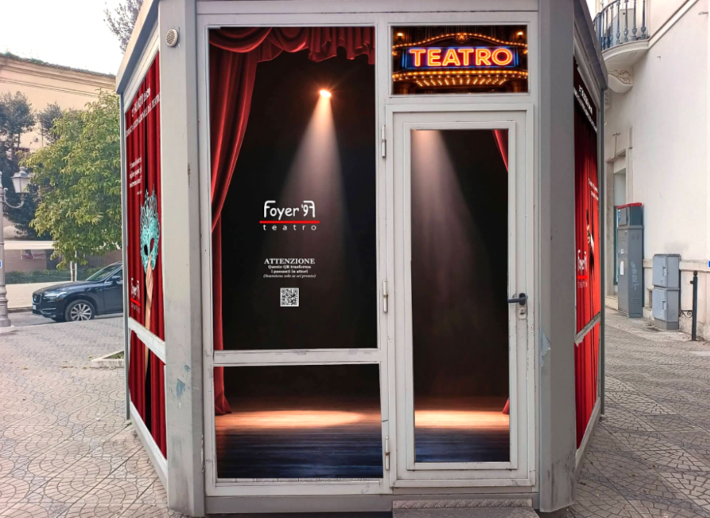
On the morning of March 27, 2026—World Theater Day—a metal shutter rolled up on a quiet street in San Severo, a provincial town of fewer than 50,000 in the Puglia region of southern Italy, roughly the latitude of Malibu but an ocean removed from any Hollywood conversation. What was revealed behind it was not a flower stand, not a coffee window, not the kind of granita cart that tends to colonize Italy’s defunct news-stands. Behind it was a theater. Six chairs. Eleven performers. Fourteen minutes and fifty-nine seconds of Chekhov, or Goldoni, or Giorgio Gaber. Then out you go, six new strangers file in, and it starts again.
Francesco Gravino—director, actor, and artistic director of the San Severo-based theater company Teatro Foyer ’97—had spent two weeks transforming a decommissioned newsstand kiosk into what has since been widely called the “world’s smallest theater.” The distance from the audience to the stage is less than a meter. There is no fourth wall because there is barely a third. Audience members walked out with tears in their eyes, or with what Gravino described as, “a suspended smile, as if they had witnessed something secret.”
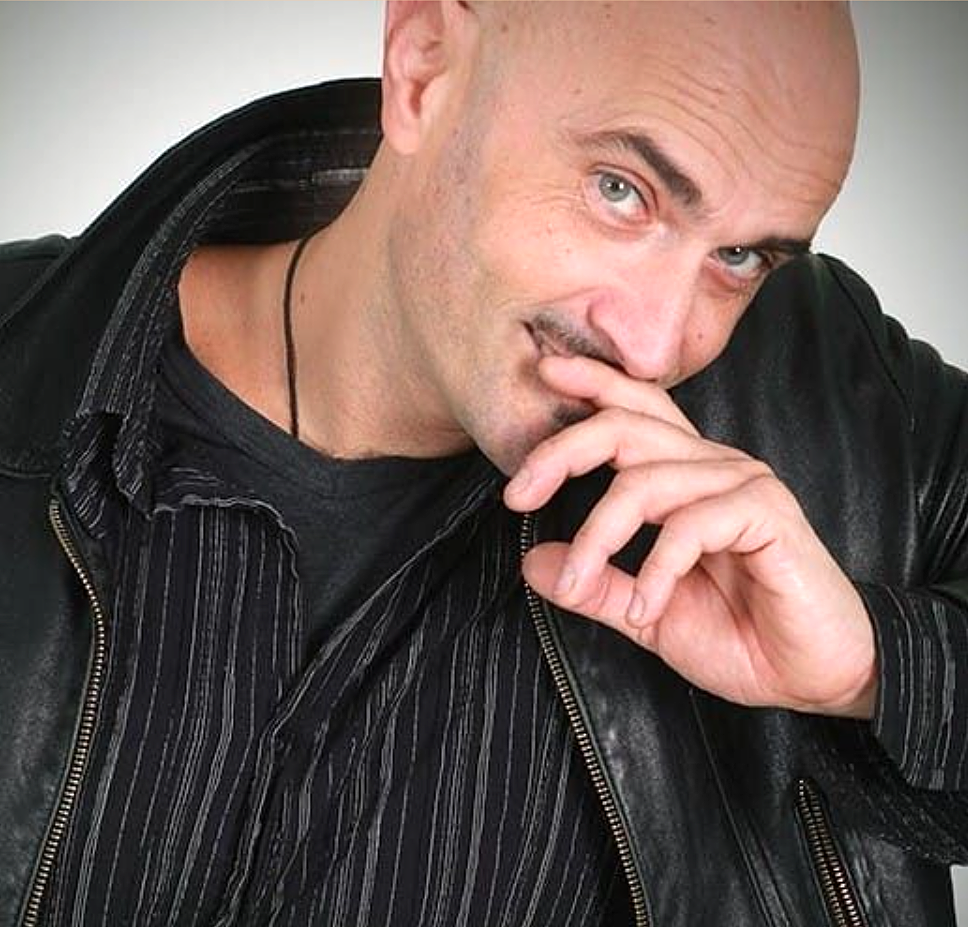
Artistic director of Foyer ‘97 theatrical company, Mr Francesco Gravino: his “world’s smallest theater” emerged from a challenge to distill theater to its core, transforming a once‑ordinary kiosk from a place of news into a vessel for emotion. (Photo credits: Luciano Magaldi Sardella/Gravino’s Foyer ’97).
In a city like Los Angeles—where the Ahmanson commands a cast of thousands, the Pantages bills itself as “Broadway in Hollywood,” and even the humblest black-box stages on Santa Monica Boulevard feel architecturally ambitious by comparison—the concept might read as a curiosity, a novelty project from the global periphery. It is neither. What Gravino built in southern Italy is, in fact, the logical endpoint of a conversation that Los Angeles theater practitioners have been having for decades: how small can a stage get before it stops being a stage? And what happens to performance when the answer turns out to be: much smaller than anyone imagined?
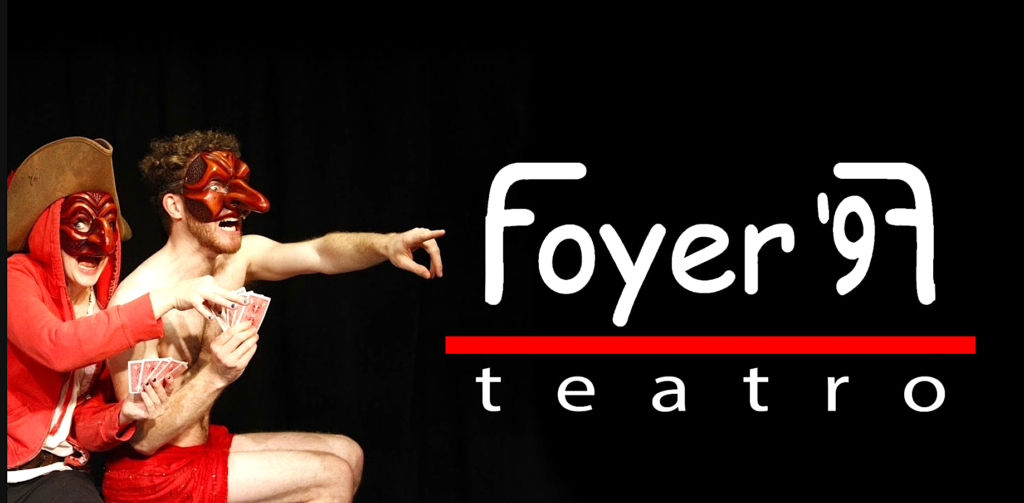
Foyer ’97’s teatro visual identity reflects its mission to renew grassroots theater, turning a simple graphic sign into a symbol of collective creativity and civic imagination. (Photo credits: Luciano Magaldi Sardella/Gravino’s Foyer ’97).
A City That Knows Its Small Stages
Los Angeles has long understood that intimate theater is its own art form. The city’s 99-seat venues—a classification born of a long-running negotiation with Actors’ Equity that became something of a cultural institution in its own right—have historically functioned as the conscience of a performing arts landscape otherwise dominated by touring productions and screen productions. Companies like Rogue Machine on Melrose, the Odyssey Theatre Ensemble in West LA, and the Victory Theatre Center in Burbank have spent decades arguing, through sheer artistic output, that the most transformative performances happen not in grand houses but in rooms where you can hear an actor breathe.
The Hollywood Fringe Festival, which returns to Santa Monica Boulevard every June, takes that argument further still: by flinging open its registration to any artist who can secure a venue and pay an entry fee, it has incubated some of the most formally adventurous theater in the American west—work staged in bars, in parking structures, in repurposed commercial storefronts. The Fringe’s operating ethos, that theater belongs wherever people are willing to show up, is not so distant from the philosophy that sent Francesco Gravino out with a box of folding chairs and a renovation permit.
And Los Angeles, for its part, has its own recent analog. Earlier this year, Ethan Marks, a street artist in downtown LA quietly unveiled the Electrical Box Theatre—a standard-issue municipal utility box, lined in red velvet, fitted with a small gold mirror, open for booking by anyone with a sketch, a song, or a three-minute poem to deliver. It was whimsical, it was impermanent, and it said something true about where theater’s center of gravity is shifting, away from the institution, toward the encounter.
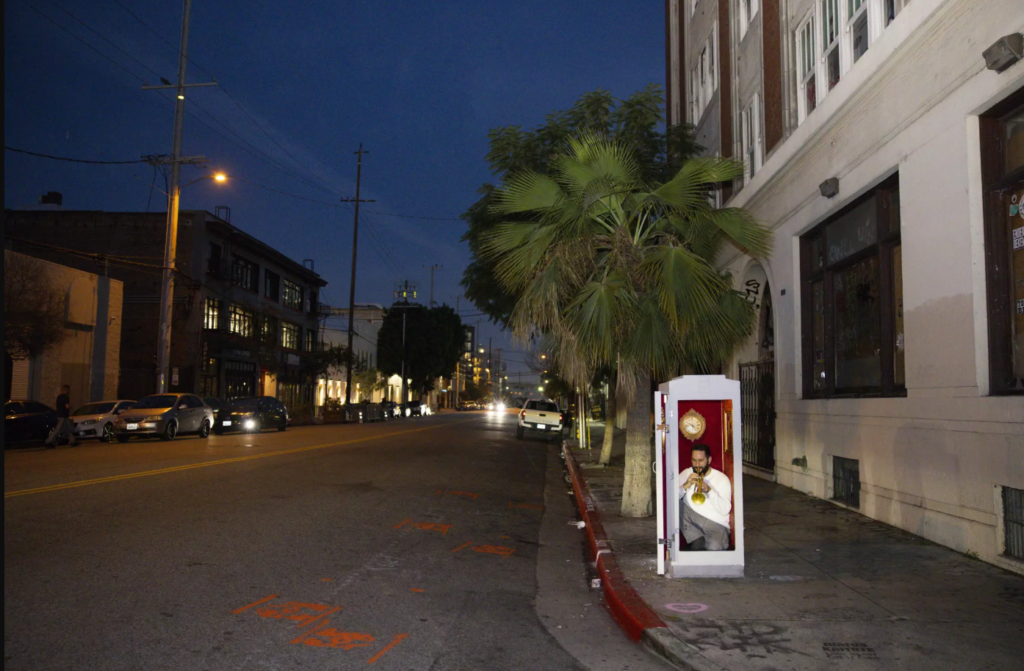
Ethan Marks inside S.C. Mero’s theater inside a fake electrical box. The guerrilla art piece is near the American Hotel. (Photo credits: Los Angeles Times).
What the Kiosk Actually Is
The Teatro Edicola—”newsstand theater” in Italian—occupies a hexagonal metal-and-glass kiosk on Via Matteo Tondi in San Severo, a structure that had been shuttered since the collapse of Italy’s print media economy nearly six years prior. Its owner, a local man named Pino Frau, offered it to Gravino’s company free of charge, a gesture that made the entire project possible without a euro of institutional funding. Gravino and his team of eleven performers spent roughly two weeks renovating the space, and launched it on World Theater Day, March 27, as what was initially conceived as a single-weekend event.
It did not stay that way. Hundreds of curious visitors lined up in the street across the inaugural weekend, waiting their turn for fifteen-minute rotations in the metal booth. Eleven actors rotated through micro-productions drawn from the canon—Goldoni, Chekhov, Ibsen, Dacia Maraini, and Giorgio Gaber among them. Italy’s national wire service, ANSA, picked up the story within days. The mayor and deputy mayor of San Severo received Gravino and his ensemble at city hall. The project earned its own entry in Grokipedia, the AI-powered encyclopedia launched by xAI, making it one of the few Italian cultural projects to receive that kind of recognition in the platform’s early iteration. The company is now pursuing a Guinness World Record for the world’s smallest theater.
On the door of the Teatro Edicola, Gravino placed a QR code with a deliberately confrontational message: “Warning! This QR code transforms passersby into actors. Scan only if you’re ready.” It is a theatrical manifesto compressed into a single sentence—one that draws a line not to exclude, but to ask everyone who approaches it to cross consciously.
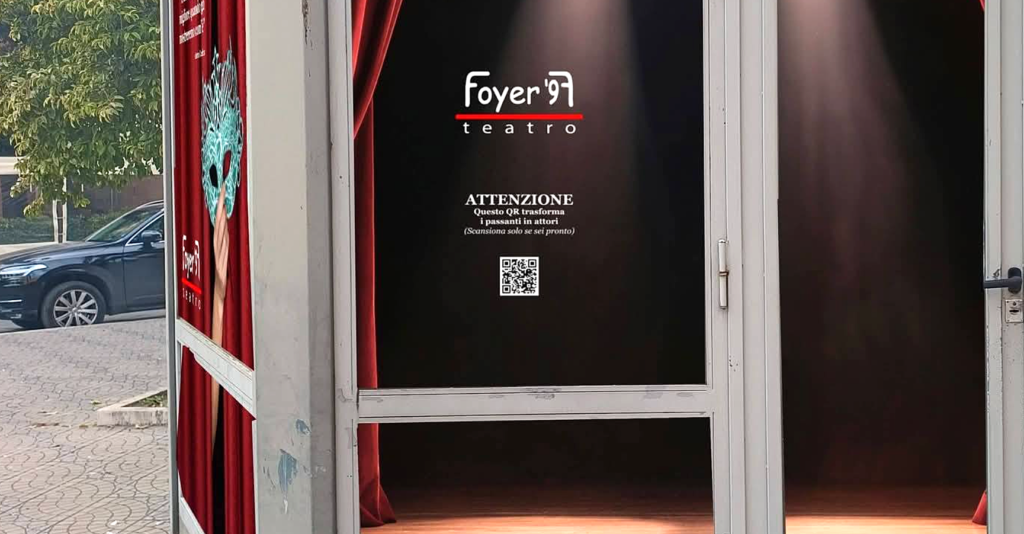
On the door of the ‘Teatro Edicola’, Gravino placed a QR code transforming passers-by into actors (Photo credits: Luciano Magaldi Sardella/Gravino’s Foyer ’97).
Gravino has cited the Italian entertainer Fiorello, whose cult television format Edicola Fiore ran from 2011 to 2017 and pioneered the concept of performing inside a working Rome newsstand, as an early inspiration. But the ambition here extends beyond television nostalgia. Gravino is also explicitly drawing on the philosophy of Willem Dafoe—current artistic director of the Venice Biennale’s theater section—on theater as a binding force between peoples.

Willem Dafoe, iconic protagonist of the World Theater Day (Photo credits: World Theater Day website).
Urban Regeneration as Artistic Act
For anyone tracking the relationship between urban vacancy and cultural reinvention—a conversation as alive in East Hollywood and South LA as it is in Puglia—the Teatro Edicola has a dimension that goes beyond the theatrical. Italy has seen the number of active newsstands fall from roughly 35,000 in 2005 to approximately 20,000 in 2024, a decline driven by the same structural forces—digital media, declining print circulation—that have hollowed out neighborhood anchor businesses from Rome to Reseda. Gravino’s kiosk, closed for six years before it became a stage, is a symptom of that shift. What his company did with it is a counterargument.
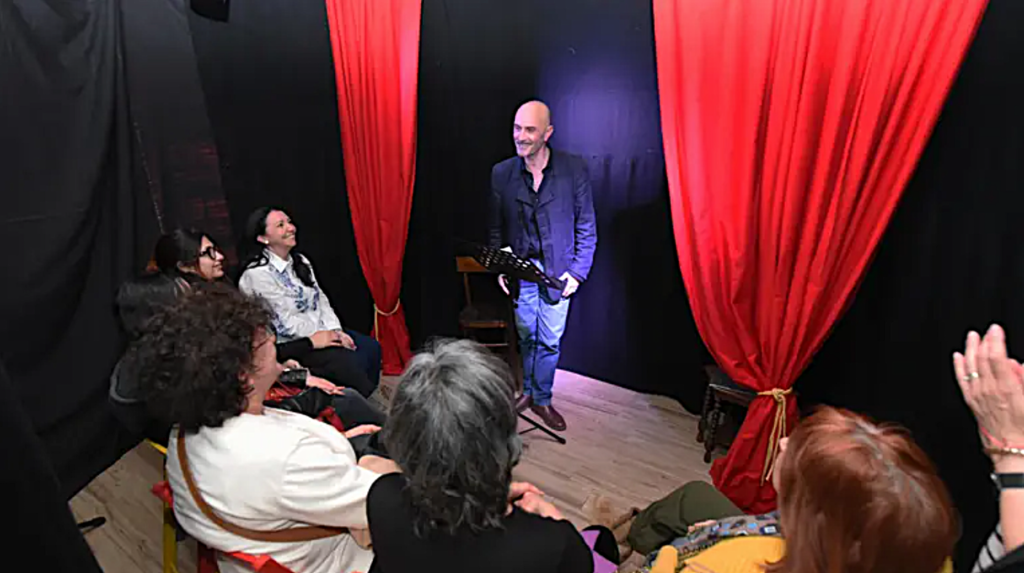
Inside the “Theater-Newsstand” in San Severo, just 6 seats for 6 spectators and Gravino acting his 15-minute part (Photo credits: Luciano Magaldi Sardella/Gravino’s Foyer ’97).
In Los Angeles, the analogous challenge takes the form of shuttered storefronts, vacant retail corridors in neighborhoods bypassed by the commercial economy, and spaces that fall into institutional no-man’s-land between too small for a developer and too expensive for a grassroots tenant. What the Teatro Edicola suggests—and what the Hollywood Fringe has been demonstrating empirically for over a decade is that the cost of activating those spaces culturally can be astonishingly low when the idea is sharp enough. Gravino’s renovation cost: roughly two weeks of labor and a box of chairs. The return: national press coverage, city hall recognition, a potential Guinness record and a conceptual model exportable to any city on earth with a shuttered kiosk and a company willing to take the keys.
The municipal government of San Severo said it plainly in its official statement: “You don’t need large investments to create culture. You need ideas that bring a community together.”
A Philosophy of Proximity
Teatro Foyer ’97 has been operating out of San Severo since 1997, producing shows, running inclusive workshops, and developing educational programs for adults, students, people with disabilities, and teachers. After nearly three decades of what Gravino calls “nomadic wandering” from one borrowed space to another, the company eventually formalized its commitment to intimate performance by establishing the Teatro Cantina — a cellar-level venue beneath street level that became their permanent base. If the Teatro Cantina was theater pushed underground, the Teatro Edicola is theater pushed all the way into the open, installed in a glass-and-metal kiosk that anyone walking down the street can simply encounter.
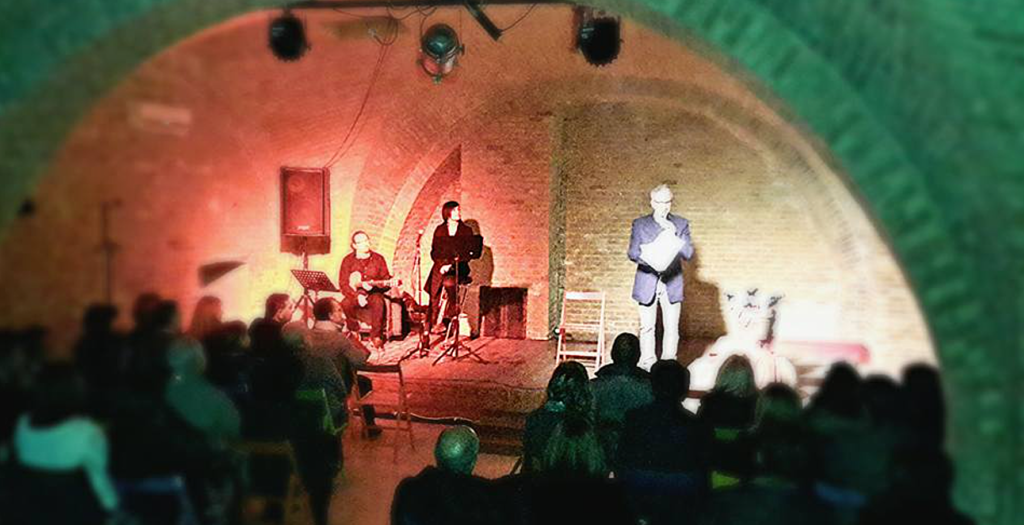
Inside the “Theater-Cellar” in San Severo, at cellar-level micro-theater with spectators and underground winehouse (Photo credits: Luciano Magaldi Sardella/Gravino’s Foyer ’97).
Read alongside the company’s other recent programming a consistent spatial logic emerges. Theater, in Gravino’s practice, moves through the city like water: finding its level, occupying every available vessel, refusing to stay in its designated room. He calls it implicitly a “theater of proximity.” The audience doesn’t travel to an institution. The institution dissolves into the street and rises wherever there’s space to stand.
Foyer ’97’s eleven performers rotate through an ongoing repertoire that draws from canonical playwrights and contemporary Italian writers alike. They give voice to adults, students, people with disabilities, teachers, and ordinary citizens through workshops and collaborative programs. They perform at wine estates in Puglia, develop EU-funded projects linking the region with Croatia, and collaborate with regional cultural bodies. They do everything, it seems, except stay still.
What Los Angeles Might Take From a Kiosk in Puglia
San Severo is not a glamorous dateline. It sits at the foot of the Gargano promontory, in a province of Foggia more frequently in the national news cycle for organized crime than for contemporary performance. That geography is not incidental to the story. It is, in some ways, the story.
In territories where cultural infrastructure is scarce and institutional funding is intermittent, a small-scale gesture—a renovated kiosk, a borrowed kiosk, a single idea—can carry social weight that a well-capitalized production in a marquee venue never could. As the cultural critic at Il Foglio, Italy’s newspaper of record for the arts, observed in reviewing the project: for there to be small theaters, there must be large theaters. San Severo, with its nineteenth-century Royal Bourbon theater, its 100-year-old Teatro Verdi, and now its six-seat kiosk on Via Tondi, has both. And now something in between.
Los Angeles, a city whose performing arts ecology spans the Ahmanson’s 1,600 seats in Downtown LA and the Fringe‘s bar-room black boxes, already understands this spectrum better than most. What the Teatro Edicola adds is a data point at the far end—a reminder that the minimum viable unit of theatrical encounter is not a room at all. It is two people, three feet apart, and the willingness of one of them to begin.
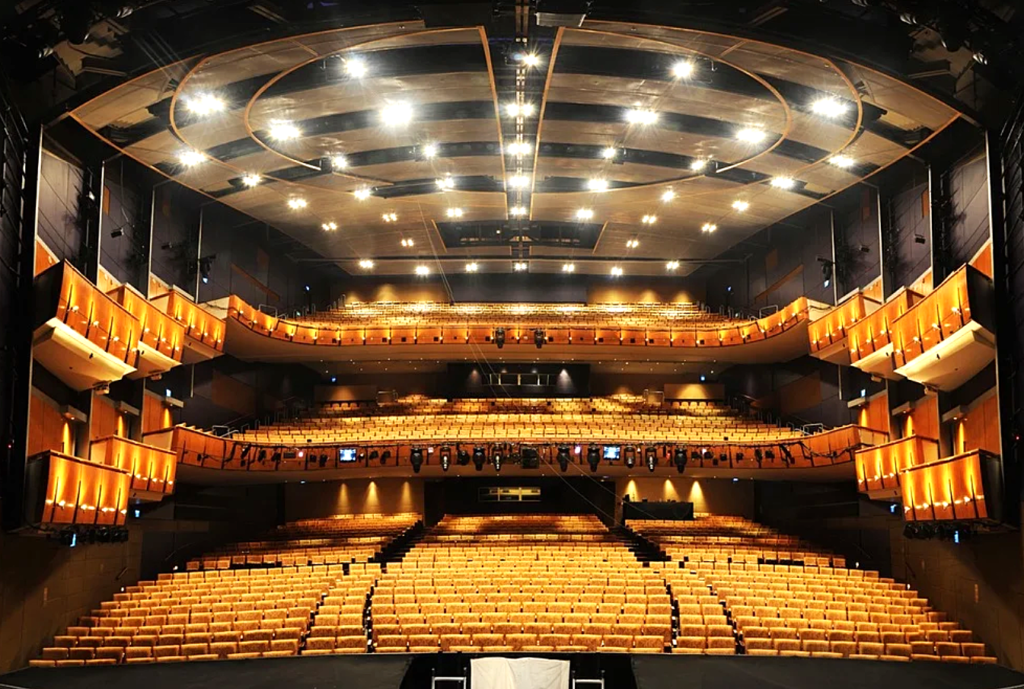
Inside Ahmanson Theater of Los Angeles downtown (Photo credits: Robert F. Mahoncy & Associates).
It is the perfect prelude to Foyer ’97’s thirtieth anniversary in 2027. Gravino is simultaneously thinking about something more permanent: acquiring the kiosk outright, scheduling ongoing performances, and exporting the format beyond Puglia. “We want to bring theater and culture outside of classical venues,” said Gravino, “into unconventional places.” It is a sentence that could have been written in a Hollywood Fringe grant application. It could have been stamped on the door of that velvet-lined utility box in downtown Los Angeles.
Whether the Teatro Edicola becomes a permanent fixture, a touring concept, or simply the thing Foyer ’97 is remembered for in 2026, one fact is already legible: this theater company built the world’s most talked-about stage in two weeks, for the price of a renovation and a box of chairs. They did it in a town most of Italy drives through without stopping. They did it with a philosophy that asks nothing of its audience except the willingness to open a door.
In Los Angeles, we have no shortage of doors. We have entire corridors of them, shuttered and waiting. The question the Teatro Edicola poses is whether we have enough people willing to roll up the shutter.
——————————————————————————————————————
About the Author:
Luciano Magaldi Sardella is an Aspire Institute (Harvard Business School) alumnus, an Italian scientific communicator, and an author whose work brings arts and cultural heritage into the public eye. Through writing, research, and media outreach, he translates complex stories into narratives that resonate far beyond the academic world.